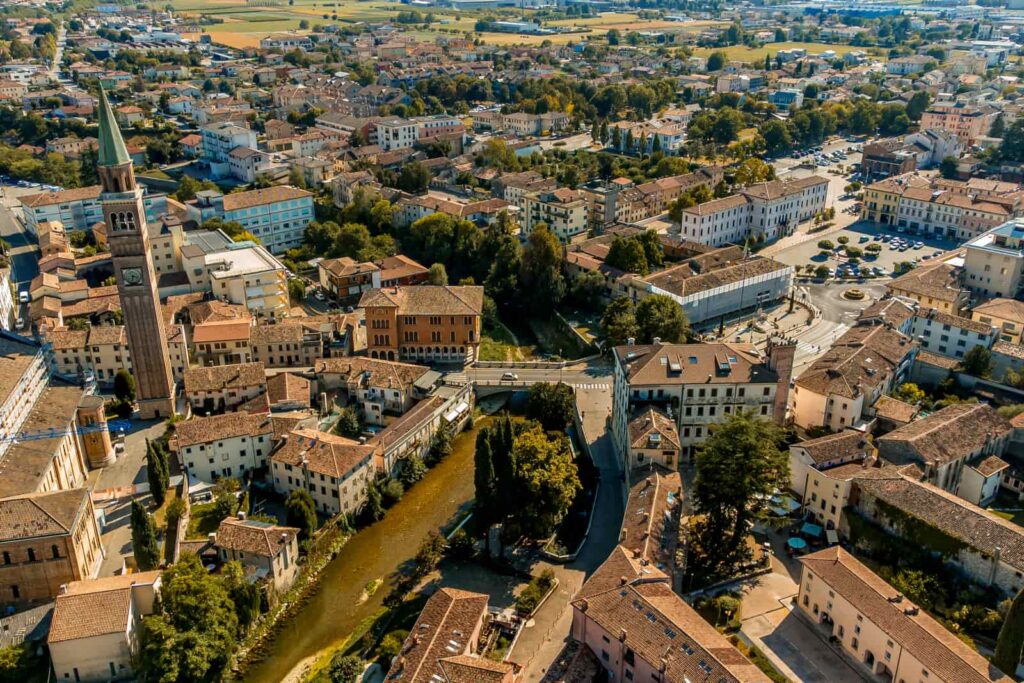
Nestled in the heart of the Treviso countryside, Pieve di Soligo is a small gem that preserves a rich historical, cultural, and natural heritage. Surrounded by the lush vineyards of the Prosecco Hills, this charming town offers visitors a perfect blend of scenic beauty and architectural treasures. Here is a guide to its most characteristic and fascinating landmarks.
Palazzo Vaccari
Piazza Vittorio Emanuele II is still today the center of the town and the main venue of the market. Here stands Palazzo Vaccari, now the town hall and formerly the city’s elementary school. The town also pays tribute here to Andrea Zanzotto, one of the greatest Italian and European poets of the 20th century, through a metal mesh artwork by the artist Mario Martinelli. The work depicts the poet’s shadow advancing, accompanied by his verse “Lontan massa son ’ndat pur stando qua” (“I have gone very far, while remaining here”), emblematic of his relationship with his homeland.
Borgo Stolfi
The heart of the historic center, the right bank of the Soligo River gives rise to one of the most evocative corners of the town: Borgo Stolfi. In ancient times, this street was home to mills and manufacturing buildings that exploited the power of water, such as the ancient Roggia, still visible today at the corner between the main street and the bridge. On the walls of the buildings facing it, stone markers and engravings commemorating the water levels reached during some of the Soligo’s floods are still clearly visible.
Cal Santa
Cal Santa is one of the most characteristic streets of Pieve di Soligo’s historic center. As early as the late 17th century, it held religious importance due to the presence of a Via Crucis connecting the Cathedral and the cemetery. Andrea Zanzotto spent some of the happiest years of his childhood and youth here. The poet loved this neighborhood so much that he called Cal Santa his “Zauberkraft”, the magical district. The house where Andrea Zanzotto lived is now home to the foundation bearing his name.
Andrea Zanzotto’s Childhood Home
The essence of the Childhood Home, located along Cal Santa, lies in the history of those who lived there. It preserves childhood and family memories, emotional bonds, and recollections of young Andrea’s education, youth, and part of his adult life. It is an example of mid-19th-century Venetian architecture, accessed through a portico embellished with frescoes by Giovanni Zanzotto, Andrea’s father, which opens onto a small garden.
The house can be visited only on special occasions.
Cathedral of Santa Maria Assunta
The Cathedral of Pieve di Soligo, with its 75-meter-high bell tower, is a 20th-century masterpiece inspired by Romanesque style. Designed by Domenico Rupolo, it hosts a dialogue between different eras, ranging from precious 17th-century altars to 20th-century works by local artists Marta Sammartini and Giovanni Possamai. Among its treasures stands out the chapel housing the Altarpiece of the Assumption by Francesco da Milano (1540).
Corte Morona and the Chapel of Our Lady of Mount Carmel
The Corte Morona complex is part of a 17th-century villa, recently restored and now home to residences and shops. In addition to the ancient well and valuable architectural elements such as arches and staircases, beneath the entrance arch there is a plaque reproducing some verses that Andrea Zanzotto dedicated to this place. The complex also includes the small Baroque church a few steps ahead, which preserves a painting of the Virgin by Giovanni Zanzotto (1888–1960), father of the famous poet.
Ponte del Contenzioso (Bridge of Dispute)
The bridge connecting the two banks of the Soligo—once administered by the Municipality of Treviso on the right bank and by the podestà of Cison on the left—was originally built of red-painted wood, rested on a single central pier, and was covered by a roof. In recent times, the roof was demolished under the pretext that people sheltered there on rainy days, obstructing traffic. Its name derives from the frequent disputes that took place there, earning it the historical name “Bridge of Dispute.”
Loggia dei Grani
The loggia was built at the request of the Counts Balbi Valier around the second half of the 19th century, acquiring a commercial and mercantile role, as the square in front hosted the grain and livestock market. Within the historic loggia there was an ancient tavern, a place of negotiations, which has since been renovated and reopened following restoration work.
Church of San Martino
The first evidence of a small chapel on this site dates back to 1177. The ancient church was replaced in 1842 by the present neoclassical temple dedicated to Saint Martin, commissioned by the Balbi Valier family—an illustrious family of Pieve di Soligo—to house their tombs. For this reason, several gravestones of the Balbi Valier and Sammartini family members are placed under the entrance colonnade.
Church of Santa Maria Maddalena
The Church of Santa Maria Maddalena is located in the western part of the town center. It is an ancient religious building dating back to 1608 and dedicated to Saint Mary Magdalene, patron saint of Pieve di Soligo. Inside the church today are two late-17th-century wooden altars and two wooden figures attributable to the painting style of the “Tenebrosi,” active between the late 17th and early 18th centuries, associated with Antonio Lazzarini (Belluno 1672–1732) and Ludovico Pozzoserrato (Antwerp 1550–Treviso 1604).
Fondaco del Gusto
The Fondaco del Gusto represents a passionate and authentic tribute to the food and wine culture of the Treviso area. Located in the heart of Pieve di Soligo, it was conceived as an emporium where food and history meet—a place of exchange, experience, and cross-pollination, where the area’s gastronomic heritage and all its key figures can discuss, compare, and grow in awareness and participation.
La Via dei Troi
In Pieve di Soligo, it is possible to experience both town and nature along an easy and evocative two-hour walk that leads from the Ponte del Contenzioso in the historic center to the village of Solighetto, near Villa Brandolini. From the bridge over the Soligo, the route heads toward Borgo Stolfi, following the road to the next pedestrian bridge leading to the Donor’s Park and Soligo Park. Continuing along Via dei Troi, one reaches Solighetto, where the Antico Maglio di Pradella is located.
Maglio di Pradella
The Maglio di Pradella is a historic site dating back to the 16th century, where iron was mainly worked using two powerful hammers driven by water power. Operational until 1984, the iron processed here came mainly from railway tracks or the rims of train cars and locomotives and was used to produce agricultural tools.
Villa Brandolini
Built in the 18th century, the rich Villa Brandolini complex includes, in addition to the villa itself, the barchessa, the guesthouse, the garden, and the private chapel. Typically Venetian in style, it is adorned with refined stucco decorations of Venetian influence, added a few decades after the villa’s construction. Following damage sustained in the post-World War I period, local artist Emilio Fontana carried out the decorative restoration.
The villa now hosts exhibitions, the “Toti dal Monte” music school, the “Consorzio di Tutela del Conegliano Valdobbiadene Prosecco Superiore,” and the Francesco Fabbri Foundation Onlus.
Church of Sant’Andrea and the Immaculate Conception
The first record of the church dates back to 1177, when a chapel dedicated to Saint Andrew stood here. However, it was only in the early 19th century, thanks to the intervention of Count Gerolamo Brandolini Rota, that the small and plain building was replaced by the current single-nave neoclassical church. The frescoed ceiling, depicting the Proclamation of the dogma of the Immaculate Conception, is the work of Giovanni Demin of Belluno.
Church of Santa Caterina
The Church of Santa Caterina as we know it today was built in 1902, when a larger structure facing west was erected, following the strict principles of Neoclassicism. Inside, the original late-17th-century baptismal font is preserved, along with works by Giovanni Zanzotto and Guido Pini.
Church of San Tiziano Patean
The small Church of San Tiziano has very ancient origins and is believed to have been built following a vow made to Saint Tiziano for deliverance from a plague. Restored around 1860, it houses an altarpiece by Palma il Giovane depicting the Madonna enthroned with the Child and Saints.
Pieve di Soligo tells its story through every church, villa, piazza, and hidden corner. A journey through art, culture, and tradition awaits every visitor, offering a unique experience in the heart of Veneto. Whether you love history, nature, or good food, Pieve di Soligo has something special for you.
Marcadoc | 30/01/2026