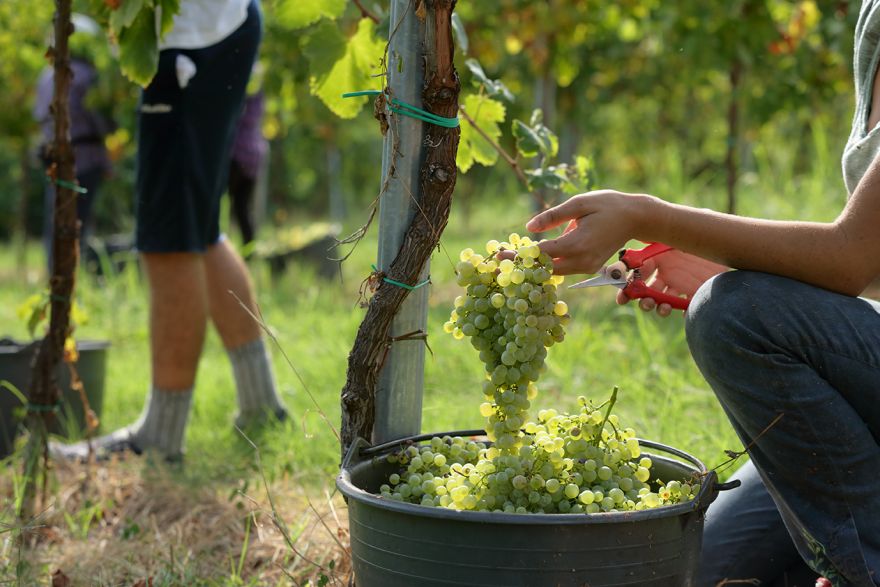
The harvest forecasts presented during the second meeting of the Trittico Vitivinicolo project regional production to be higher than those of 2024.
Grapes in excellent condition and the health situation under control: the 2025 harvest in Veneto promises to be one of the best in recent years. This is the finding of the second meeting of the 51st edition of the Trittico Vitivinicolo Veneto, held online on the morning of Friday, August 22nd, with the participation of the Regional Councilor for Agriculture, Federico Caner, the director of Veneto Agricoltura, Nicola Dell’Acqua, and the director of CREA Conegliano, Riccardo Velasco.
The event, organized by the Veneto Region and Veneto Agricoltura in collaboration with CREA, ARPAV, and AVEPA, provided industry professionals with a forecast for the upcoming harvest, with specific insights into expected production levels and the quality of the grapes that will go into producing Veneto’s prized wines.
The forecast data for Veneto, presented by Patrick Marcuzzo of CREA, offers hope: compared to 2024, when 1,374,400 tons of grapes were produced, approximately 100,000 more tons are expected.
In 2025, the damage caused by downy mildew was much less severe, while losses from hail were almost equivalent to those of 2024. Furthermore, the summer weather, analyzed by Fabio Zecchini of ARPAV, did not have a negative impact: although 2025 was among the hottest years in the last seventy years, and the heat waves of June and August proved particularly long-lasting and intense, a cool July with record rainfall (it was the second wettest July in Veneto after 2014) rebalanced the situation.
In this context, fertility levels have increased, and the weight of the grapes has increased on average compared to last year. The most renowned grape varieties are thus in optimal condition, and, in terms of production, all appear, on average, to have increased slightly.
More specifically, data compiled by the Veneto Agricoltura Agri-Food Economic Observatory highlights variations by province. While Belluno will be essentially in line with 2024 (+1%), in Padua and Rovigo, an increase of up to 10% is expected for Glera, Pinot Grigio, Merlot, and Cabernet. Production in Treviso will also be stable, with the exception of Pinot Grigio (+2%) and Glera (-3%), a grape variety that is growing in the Venice area (+5%) along with Chardonnay (+3%), while Pinot Grigio is declining (-3%). For Vicenza and Verona, it will be a particularly positive year, with increases of up to 15% for Merlot and 10% for Corvinone and Garganega.
“Despite this season being characterized by some rainfall and above-average temperatures,” commented Councilor Caner, “we have managed our vineyards optimally. This is confirmed by the production prospects, which, in both quantity and quality, are more than good: we are expecting a significant harvest. The only concern is the international context, given the confirmation of tariffs by the United States, but the Veneto region is perfectly capable of managing this increase. In this regard, we are closely monitoring the European Union’s wine package: it is a tool that can help us mitigate the consequences of the tariffs. Furthermore, the American market is not the only existing one: I always urge our producers to also seek new opportunities elsewhere, because, in the current context, opening additional borders can bring great satisfaction.”
The second meeting of the Wine Triptych also served to foster direct dialogue with other Italian and international wine regions, thanks to the playback of video contributions in which operators from Piedmont, Lombardy, Emilia-Romagna, Tuscany, Puglia, Sicily, France, and Spain presented their harvest forecasts in their respective geographical areas.
Overall, the Italian situation appeared positive, with the only remaining question marks related to tariffs and the disposal of stocks in the face of increased production.
Press release from Veneto Agricoltura